Announcement
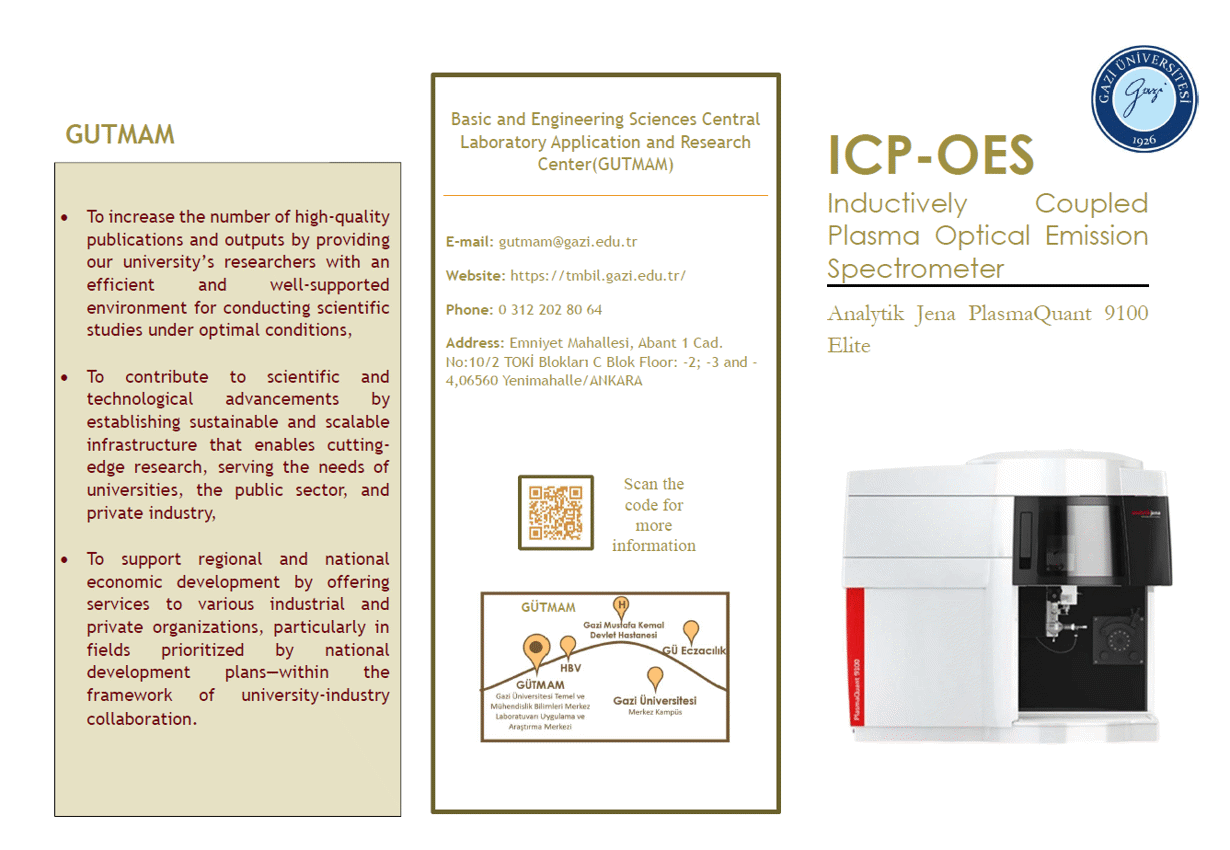
ICP-OES Inductively Coupled Plasma Optical Emission Spectrometer
9 January 2025 | 11:21
Device Specifications
Analytik Jena's PlasmaQuant 9100 Elite model is one of the advanced ICP-OES systems, standing out with features such as high resolution, fast analysis, and low argon consumption. The Echelle double monochromator system and CCD detector allow for highly sensitive measurements over a wide wavelength range. Reliable results are obtained even at challenging detection limits thanks to the 1700 W high-power surgical RF plasma source. The Dual View technology enables precise analysis across wide concentration ranges by providing both axial and radial plasma observation. Furthermore, all optical components are housed on a compact and environmentally resistant platform, supporting the device's long lifes and stable operation.
Application Areas
Reliable analysis of various sample types (water, soil, food, metal, etc.) at low concentrations, independent of different matrix effects.
Obtaining low error results in analyses such as industrial quality control and purity measurement.
Used in fields such as biology, chemistry, environmental science, food technologies, materials science, medicine and pharmaceutical industry, petrochemicals, etc.
Working Principle
ICP-OES (Inductively Coupled Plasma Optical Emission Spectrometry) is an analytical method used to determine the concentrations of elements in a sample. The liquid sample is converted into tiny droplets (aerosols) via a nebulizer. This aerosol is introduced into an argon plasma which reaches a temperature of approximately 10,000 K. In the plasma, the element atoms ionize and become excited. The excited atoms emit light at characteristic wavelengths as they return to their ground state. This light is separated by optical system and measured by detectors to determine the concentration of each element. Analytik Jena’s PlasmaQuant 9100 ICP-OES instrument is ideal for both general and specialized analyses, as well as fast/high-capacity analyses analyses. The device is widely used, particularly in areas such as environmental analysis, water quality control, and metal content determination.
Technical Specifications
Monochromator: Echelle dual monochromator, quartz prism front monochromator, 400 mm focal length, 5 different adjustable extrance/exit slits and fixed/oval slit (entrance slit dimensions: 35 x 1800 µm)
Wavelength Range: 160 – 900 nm
Wavelength Accuracy: < 0.4 pm
Spectral Resolution: 0.002 nm (at 200 nm)
FWHM: ≤ 3.5 pm (As (193.696), Tl (190.796))
RF Amplifier Frequency: 40 MHz Generator, Free-running
RF-Tube Generator: 40 MHz
Detector: Charge Coupled Device (CCD)
Sample Preparation
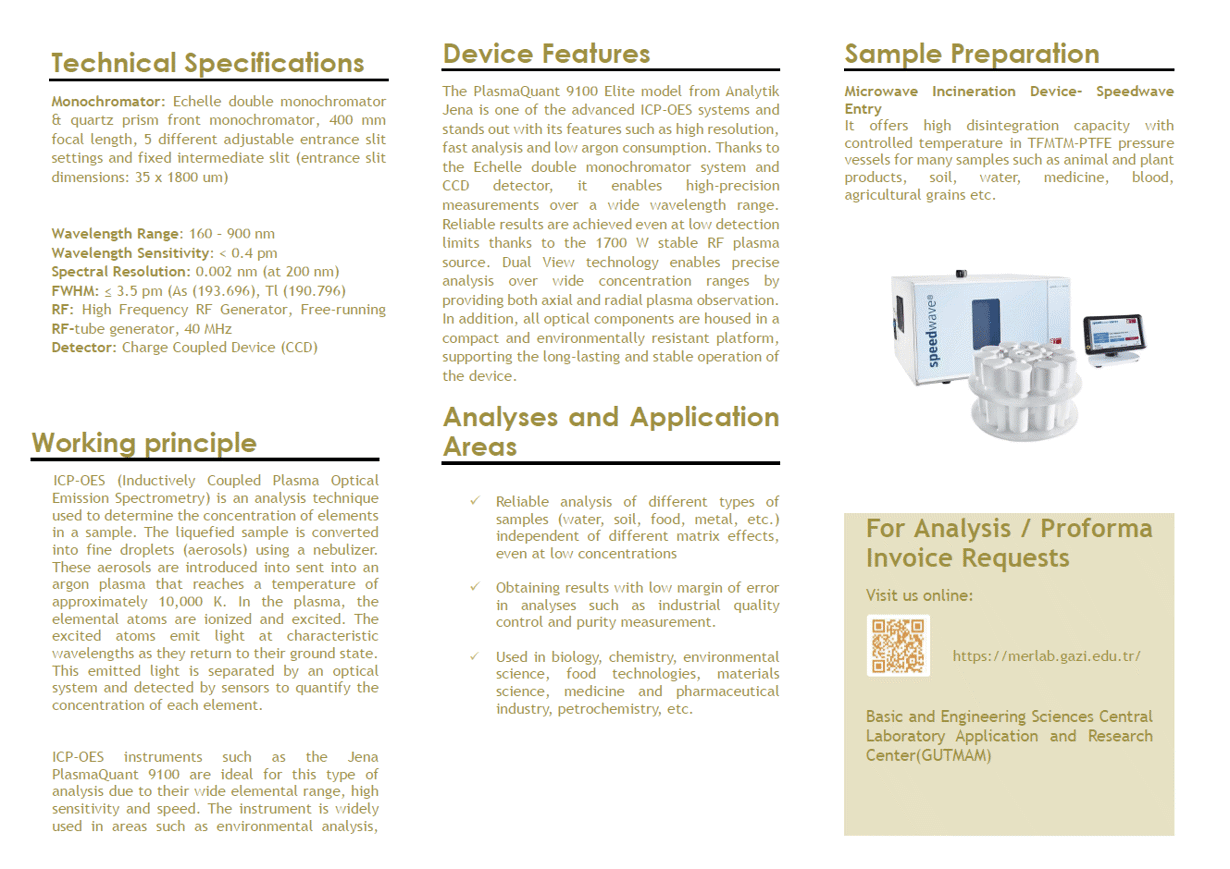
The Speedwave Entry Microwave Digestion System offers controlled temperature and high decomposition capacity within TFMTM-PTFE capped vessels for various samples such as animal and plant products, soil, water, medicine, blood, agricultural, cereals etc.
Other Announcements
Confocal Raman Spectroscopy Device User Training Conducted at GUTMAM
Material Characterization with XRF Device
Publication of the KIDR 2024 Report on Unit Web Pages
Our XRF and surface area porosity analysis services have started
GUTMAM Elemental Analysis Laboratory
GÜTMAM was honored with the bes practice example award in the " Research and Development" category